Tajikistan Pamir Highway Adventure: 2026 Overlanding Guide
Explore the 1,252 km Pamir Highway in 2026 with step-by-step visa, permit, gear and fuel planning for overlanders and motorcyclists tackling 4,655 m passes.

This post may contain affiliate links. Disclosure
The Pamir Highway — officially the M41 — stretches 1,252 km from Dushanbe to Osh, threading the roof of the world at a dizzying 4,655 m at Ak-Baital Pass. In 2026 the route is finally open end-to-end after Kyrgyz-Tajik border points were re-demarcated, meaning the classic overland pilgrimage can be completed without detours for the first time since the early 2000s. Tourist arrivals to Tajikistan surged 31.3% year-over-year in the first half of 2025, reaching 925,700 foreign visitors — a tide that shows no sign of slowing. For the serious overlander or long-haul motorcyclist, the highway is a test of altitude acclimatization, fuel logistics, and bureaucratic precision. This guide breaks down every non-negotiable step: visa and GBAO permit acquisition, the optimal June-September travel window, essential gear that survives 4,000-plus-meter deserts, and how to keep your tank topped up when the next fuel pump is 400 km away.
Short answer: The Pamir Highway, officially the M41, runs 1,252 km from Dushanbe to Osh and tops out at 4,655 m on Ak-Baital Pass. Following Kyrgyz-Tajik border re-demarcation the route is finally open end to end again in 2026. You need both a Tajik visa and a separate GBAO permit before you start.
Route Overview and Elevation Profile

The M41 is more than a road; it is a living museum of Silk Road history. Marco Polo traversed this plateau in 1271 on his journey to China; the modern highway was built primarily by the Soviet Union in the 1930s as a strategic supply corridor into the Gorno-Badakhshan Autonomous Oblast (GBAO). Starting at Dushanbe (800 m), you climb through the fertile valleys of Kalaikhumb (1,227 m) before entering GBAO. The first major hub is Khorog (2,200 m), a river-cut town perched on the Panj. From there the road climbs sharply to Murghab (3,600 m), the last reliable fuel stop before the legendary Ak-Baital Pass (4,655 m) — the second-highest international highway in the world. After the pass you descend to Lake Karakul (3,914 m) and swing past the Kyzyl-Art Pass (4,280 m) before dropping into Osh (963 m) in Kyrgyzstan.
Key waypoints with approximate elevations:
| Kilometer Marker | Location | Elevation (m) |
|---|---|---|
| 0 km | Dushanbe | 800 |
| 210 km | Kalaikhumb | 1,227 |
| 340 km | Khorog | 2,200 |
| 560 km | Murghab | 3,600 |
| 720 km | Ak-Baital Pass | 4,655 |
| 850 km | Lake Karakul | 3,914 |
| 960 km | Kyzyl-Art Pass | 4,280 |
| 1,252 km | Osh | 963 |
Because the road traverses deep valleys and exposed ridgelines, GPS lock can be intermittent. Expect to rely on pre-downloaded topo maps and satellite communication for safety in the remote GBAO stretches.
Visa and GBAO Permit Essentials

Getting the paperwork right is the single most important pre-trip task. Two documents are mandatory: the Tajikistan e-Visa and the GBAO Permit. Miss either and you will be turned back at the first checkpoint in Khorog.
-
Tajikistan e-Visa — Apply online at the official portal (visatajikistan.com). A single-entry visa costs $30 USD and a multiple-entry visa $50 USD; both are valid for up to 60 days. Over 60 nationalities can apply entirely online and approvals typically arrive within 24 hours.
-
GBAO Permit — Mandatory for any travel inside the Gorno-Badakhshan Autonomous Oblast. Add the $20 USD permit fee to your e-Visa application; processing takes 2-3 business days. The permit is issued as a PDF that must be printed and shown at border checkpoints in Khorog and Murghab.
-
Border Reopening 2026 — The March 2025 agreement between Kyrgyzstan and Tajikistan reopened the Guliston-Kyzyl-Bel crossing, allowing a seamless Dushanbe-to-Osh overland trek for the first time since the early 2000s. No additional paperwork is required beyond the standard Tajik visa and GBAO permit.
-
U.S. State Department Advisory — The U.S. advises heightened caution due to terrorism risk near the Afghan border, unexploded landmines, and periodic instability in GBAO. Review the full advisory: U.S. State Department — Tajikistan Travel Advisory.
Keep digital copies of your visa, permit, and passport on a secure cloud service, but also carry printed versions in a waterproof pouch. Remote checkpoints often lack reliable internet, and rangers expect physical documents.
Season and Border Timing

The optimal window is June through early September. Snow typically melts from the high passes by early June, and the road remains clear until late September when early snowfall can re-close mountain passes. Attempting the route in May risks being stranded at Ak-Baital Pass; October travel may encounter sudden snowstorms and reduced services in Murghab.
Because the Guliston-Kyzyl-Bel crossing is newly reopened, expect a brief adjustment period during 2026’s inaugural season. Customs officers may still be calibrating procedures, so allocate an extra 2-3 hours at the checkpoint for paperwork verification. Carry snacks and water — queues can stretch through midday heat in summer.
Day length is generous in June and July, with up to 16 hours of light above 3,500 m. Plan your longest driving legs for those months, and use the extended dusk to scope campsites before dark. By late August, temperatures at Ak-Baital can drop below -5 degrees Celsius overnight even on clear days, so cold-weather gear stays in the kit regardless of your start date.
Fuel and Logistics Planning
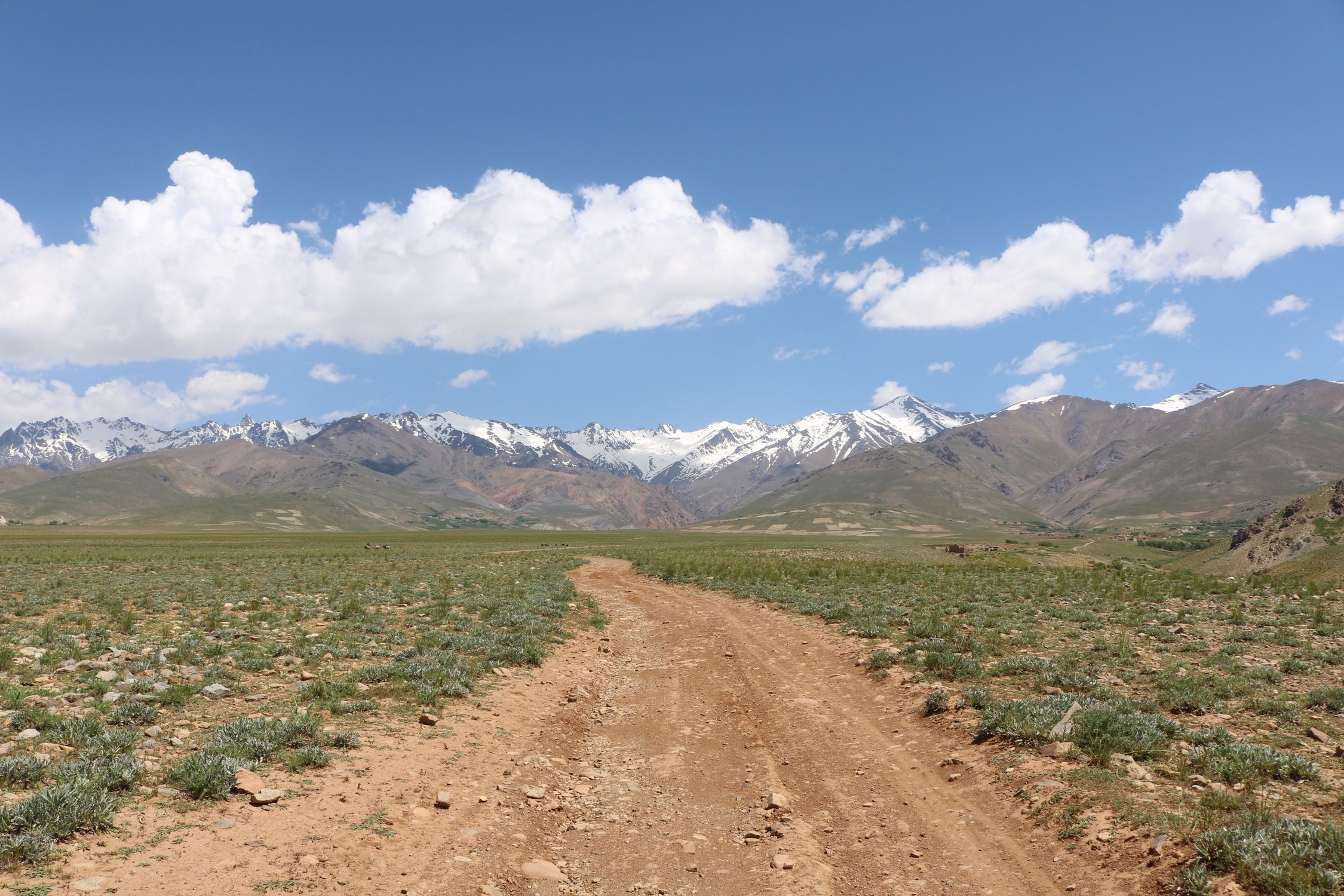
Fuel is the lifeblood of any Pamir overland expedition. The only reliable stations are Khorog and Murghab; the 400 km stretch between them can be a complete desert of diesel. Recommendations:
- Carry a minimum 30-liter reserve for the Khorog-to-Murghab leg. Use sturdy, sealable jerrycans and store them in a ventilated compartment to avoid fumes.
- Refuel early in Khorog — prices hover around $1.10 USD per liter, but the station can run out during peak season. Fill up the moment you arrive, not the morning you leave.
- Murghab offers both diesel and gasoline; the bazaar also sells kerosene, which is the recommended fuel for liquid-fuel stoves at this altitude (see Gear section).
- Backup plan — If a station is unexpectedly closed, purchase diesel from local trucks, often sold by the liter at a small premium. Always carry a reserve of USD and local somoni for informal purchases.
Budget for fuel as a fixed cost: a 30-liter fill-up in Khorog runs approximately $33 USD at 2026 prices, plus the base tank of your vehicle or motorcycle. Self-drive 4WD rental from Dushanbe operators runs $100-$120 per day including basic insurance; fuel is not included. For budget travelers using shared marshrutka minibuses, the same leg costs $5-$10 per short leg but services are limited above the passes.
Gear Checklist for Remote Pamir

Essential Satellite and Navigation Gear
| Product | Why It Matters on the Pamir | Key Specs | Price Range |
|---|---|---|---|
| Garmin inReach Mini 2 Satellite Communicator — Orange | Emergency SOS and two-way messaging where cell towers vanish (e.g., Ak-Baital Pass). | 3.5 oz, IPX7 waterproof, MIL-STD-810, 14-day battery (10-min tracking), global Iridium network | $340-$400 |
| Garmin Overlander Rugged Multipurpose Navigator | Vehicle-mounted navigation with preloaded Central Asian topo maps and iOverlander POIs for fuel stops, campsites, and emergency shelters. | 7-inch touchscreen, MIL-STD-810, 64 GB storage, GPS/GLONASS/Galileo, magnetic mount | $450-$550 |
| MSR WhisperLite Universal Compact Hybrid Fuel Backpacking Stove | Reliable cooking above 4,000 m where butane cans fail; liquid fuel (white gas/kerosene) is widely available in Murghab. | 13.7 oz, boils 1 L in 3.5 min (white gas), AirControl auto-mix, windscreen, heat reflector | $120-$150 |
Purchase links:
Why these three are non-negotiable: The inReach Mini 2 works at any altitude, including the 4,655 m Ak-Baital Pass, and its 14-day battery covers the full Dushanbe-to-Osh itinerary without recharging. Its Interactive SOS triggers a 24/7 monitoring center that can dispatch helicopter rescue from Dushanbe or coordinate with local authorities — the only realistic rescue option in remote GBAO valleys. The Overlander stores 64 GB of high-resolution topo maps; without it, Google Maps offers no offline data for GBAO, forcing reliance on spotty cellular coverage that disappears entirely between Khorog and Murghab. The WhisperLite switches to liquid fuel, which is the only fuel type reliably stocked in Murghab. Canister stoves lose efficiency above 4,000 m due to pressure drop, leaving you without hot meals or the ability to melt snow for water. The Overlander also needs manual Central Asia topo sheet downloads before departure — its default maps cover North and South America, so pre-trip prep is essential.
Additional Gear (not product-specific)
- Layered clothing system — Base layer of merino wool, insulated down jacket, and a breathable shell. Temperatures at Ak-Baital can dip below -15 degrees Celsius even in July.
- High-altitude sleeping bag — Rated to -20 degrees Celsius; nights on the plateau are brutally cold even in peak summer.
- Portable solar panel (100 W and above) — Keeps the Overlander and phone charger topped up during the long daylight stretches of June and July.
- Spare tire kit and tire repair kit — Gravel and loose basalt are common on the Murghab plateau; a puncture can cost hours in a remote valley with no cell coverage.
- First-aid kit with altitude-related meds — Include acetazolamide, ibuprofen, and a basic wound-care set. Nearest hospital-level care is in Khorog.
Safety and Communication

-
Altitude Acclimatization — Ascend gradually. Spend at least one night above 3,500 m (e.g., Murghab) before attempting Ak-Baital. Hydrate aggressively (3-4 liters per day) and consider prophylactic acetazolamide if you have a history of acute mountain sickness.
-
Emergency Protocol — Activate the Interactive SOS on the inReach Mini 2 as soon as you suspect serious trouble. The device contacts a 24/7 monitoring center that can dispatch rescue via helicopter from Dushanbe or coordinate with local authorities. Do not wait until the situation deteriorates.
-
Landmine Awareness — Certain sections near the Afghan border still contain unexploded ordnance from decades of conflict. Stick to the paved shoulder, avoid unmarked paths off-road, and obey local signage. Never venture off-road in border-adjacent areas without local guide knowledge.
-
Road Etiquette — The Pamir Highway is a shared lifeline for locals, trucks, and tourists. Yield to oncoming traffic on narrow passes, never overtake on blind curves, and reduce speed through villages where children and livestock share the road.
-
Health Precautions — Carry a water purification system (UV or chemical tablets). Even boiled water can harbor parasites at high altitude if the source is contaminated. The Panj River tributaries are the primary water sources between Khorog and Murghab.
Budget, Accommodation, and Cultural Highlights
A typical daily breakdown for a self-drive 4WD or adventure motorcycle:
| Expense | Daily Cost (USD) | Notes |
|---|---|---|
| Food (local meals) | $10-$15 | Street food, homestay cooking, occasional restaurant |
| Homestay accommodation | $10-$15 per night | Available in Khorog, Murghab, and small villages; usually includes meals |
| Shared marshrutka (if hitching legs) | $5-$10 | Useful for short legs; limited above the high passes |
| 4WD rental (self-drive) | $100-$120 | Includes basic insurance; fuel not included |
| Fuel reserve (30 L) | $33 (average) | Purchase in Khorog before heading to Murghab |
Total average per day: $40-$60 for budget travelers using shared transport and homestays; $130-$150 for self-driven overlanders covering rental, fuel, and gear amortization. Keep a cash buffer of $200-$300 for unexpected fuel price spikes or emergency lodging in remote villages where card terminals are nonexistent.
The Pamir Highway also delivers unforgettable cultural encounters. Khorog is home to the Pamir Botanical Garden and the striking Khorog Fortress; the town’s bazaars sell hand-woven textiles and dried apricots. Lake Karakul at 3,914 m is a photographer’s dream — sunrise reflections on the turquoise surface are legendary among overlanders. Murghab is the base for Yaghnob Valley side trips where ancient Yaghnobi-language speakers preserve pre-Islamic traditions. At Ak-Baital Pass, keep watch for wandering yak herders and nomadic families who have worked this plateau for centuries. Osh ends the journey at the UNESCO World Heritage-listed Sulayman Mountain — a perfect place to decompress after two weeks on the roof of the world.
Before you roll, run this list: apply for the Tajik e-Visa ($30/$50) and add the GBAO permit ($20, PDF printed); book 4WD rental or confirm motorcycle paperwork (license, insurance, carnet if required); download Central Asian topo maps onto the Garmin Overlander; purchase and activate the inReach Mini 2 with a satellite subscription; pack the MSR WhisperLite with a 1-liter fuel bottle of white gas or kerosene; fill 30 L of fuel reserve in Khorog; spend at least one night above 3,500 m before Ak-Baital; verify border crossing status for Guliston-Kyzyl-Bel; and carry a $200-$300 USD and somoni cash buffer.
With the paperwork locked, the gear tested, and the fuel strategy set, you are ready to chase the horizon across the Pamir’s stark beauty. The road will test your endurance, but the reward — vast, wind-blown plateaus, sky-piercing peaks, and the camaraderie of fellow overlanders from every corner of the world — makes every kilometer worth the effort.
Related Reading
Get price-drop alerts and new guides from BoldTripGuide
One email a week: price drops on the gear we recommend, new guides, and what changed. No spam, unsubscribe anytime.