Best Ultralight Stoves for Thru-Hiking in 2026 – Compared
Top ultralight canister stoves for AT, PCT, and CDT thru-hikers in 2026. Weight, boil time, wind performance, and cold-weather specs compared side-by-side.

This post may contain affiliate links. Disclosure
The modern thru-hiker’s pack is a calculus of grams versus gains. In 2025, 89% of Appalachian Trail hikers reported using a canister stove, and the BRS-3000T and MSR PocketRocket Deluxe dominated the leaderboard. When you’re logging 2,600+ miles on the AT, PCT, or CDT, a stove that sheds weight without sacrificing boil speed or wind resilience can be the difference between a hot breakfast at sunrise and a cold, grumbling stomach at night. Below we break down the science, the stats, and the six verified models that earned a spot in our 2026 roundup, so you can match the right stove to your skill level, climate, and budget.
Short answer: Canister stoves dominate thru-hiking: 89% of 2025 Appalachian Trail hikers used one, with the BRS-3000T and MSR PocketRocket Deluxe leading the field. Modern 80/20 isobutane-propane blends stay pressurised down to about -12°C, which covers most three-season conditions. Below that, cold-weather performance becomes the deciding specification.
Why Canister Stoves Dominate Thru-Hiking
Canister stoves combine instant ignition, consistent pressure regulation, and a compact fuel canister that fits snugly in any ultralight pack. The 2025 AT Thru-Hiker Survey via The Trek showed that 89% of respondents favored this format, largely because modern isobutane-propane blends (typically 80% isobutane, 20% propane) stay pressurized down to -12 degrees C (10 degrees F) — a critical edge over pure butane in mountain weather.
- Speed — Most canister stoves deliver 10,000 BTU/hr or more, boiling a liter of water in 2-3 minutes.
- Simplicity — No priming, no liquid fuel handling, and a single canister that doubles as a backup fire starter.
- Weight efficiency — A 100 g fuel canister fuels 12 L of water in the Jetboil Stash system, approximately 30% less fuel burn than traditional pots.
That dominance does not mean every canister stove is created equal. The real decision matrix for serious thru-hikers hinges on weight-to-performance ratio, wind handling, and cold-weather reliability — the three axes we explore in the sections that follow.
Choosing the Right Ultralight Stove
| Factor | What to Look For | Why It Matters |
|---|---|---|
| Base weight | Sub-30 g for gram-obsessed hikers; 60-90 g acceptable if you need wind protection | Every gram adds up over 2,600 miles. |
| Boil time | 3 min or less per liter in calm conditions; 2.5 min or less in wind for exposed ridgelines | Faster meals mean less time exposed to elements. |
| Wind resistance | Integrated windscreen, 4-Flex pot support, or remote canister design | High-elevation ridgelines on the PCT and CDT can hit 20 mph gusts. |
| Cold-weather regulator | Micro-regulator or inverted canister capability | Fuel vapor pressure drops sharply below freezing; a regulator keeps output stable. |
| Pot compatibility | Needle-style vs. wide-base support; ability to handle 1 L-plus pots | Solo hikers may need a 0.8 L pot; long-haul hikers often prefer 1.5 L for bulk meals. |
| Price vs replaceability | Sub-$20 models can be swapped mid-trail; premium models justify durability and features | 17% of AT thru-hikers swapped stoves mid-hike in 2025. |
With those criteria in mind, let’s dive into the six models that meet the strict verification standards of our fact pack.
Top Picks for 2026
BRS-3000T — Titanium Ultralight Backpacking Stove
ASIN: B00NNMF70U — Buy on Amazon — Price: $15-20
- Weight: 26 g (0.9 oz) — the lightest canister stove on the market.
- Output: 2,700 W (9,200 BTU/hr).
- Boil time: 1 L approximately 3 min.
- Design: Titanium alloy folds to 8.5 x 8.5 x 7 cm; nests inside a 300 ml titanium cup.
Best for: Gram-obsessed thru-hikers who need the absolute lightest stove and are comfortable sacrificing wind protection.
Pros
- At 26 g it’s the lightest canister stove available for the money.
- Sub-$20 price makes it easy to replace if lost or damaged.
- Compact fold-flat design fits inside a small titanium cup, saving pack volume.
Cons
- No windscreen; performance drops noticeably above 15 mph.
- Larger 230 g canisters can wobble on uneven terrain.
SOTO WindMaster — Canister Stove with 4Flex
ASIN: B07R7BZCB3 — Buy on Amazon — Price: $70-80
- Weight: 67 g (2.3 oz) without support, 87 g with 4Flex.
- Output: 3,260 W (11,000 BTU/hr).
- Boil time: 2 cups in under 2.5 min even in wind.
Best for: PCT and CDT thru-hikers tackling exposed ridgelines and high-elevation wind-scoured terrain.
Pros
- Micro-regulator maintains consistent output in cold temps and low-fuel canisters.
- Patented 4-Flex pot support accommodates cookware from tiny titanium cups to 1.8 L pots.
- Named 2024 Gear of the Year by The Great Outdoors Magazine; battle-tested community endorsement.
Cons
- Costs 3-4x more than budget options like the BRS-3000T.
- Requires separate TriFlex support for maximum pot-size versatility.

MSR PocketRocket Deluxe — Ultralight Canister Stove
ASIN: B07L5S65HR — Buy on Amazon — Price: $75-90
- Weight: 83 g (2.9 oz).
- Output: 11,000 BTU/hr (pressure-regulated).
- Boil time: 1 L in 3.3 min.
Best for: AT thru-hikers who demand reliable performance with built-in ignition and proven pressure regulation across temperature swings.
Pros
- Pressure regulator preserves fast boil times at high altitude and in cold weather as the canister depletes.
- Built-in Piezo igniter eliminates the need for a separate lighter.
- MSR’s most popular stove — top choice in the 2025 AT thru-hiker survey for the ninth straight year.
Cons
- 83 g is heavier than the BRS-3000T and SOTO WindMaster for ultralight-obsessed hikers.
- Broad burner head adds slight bulk compared to needle-style burners.

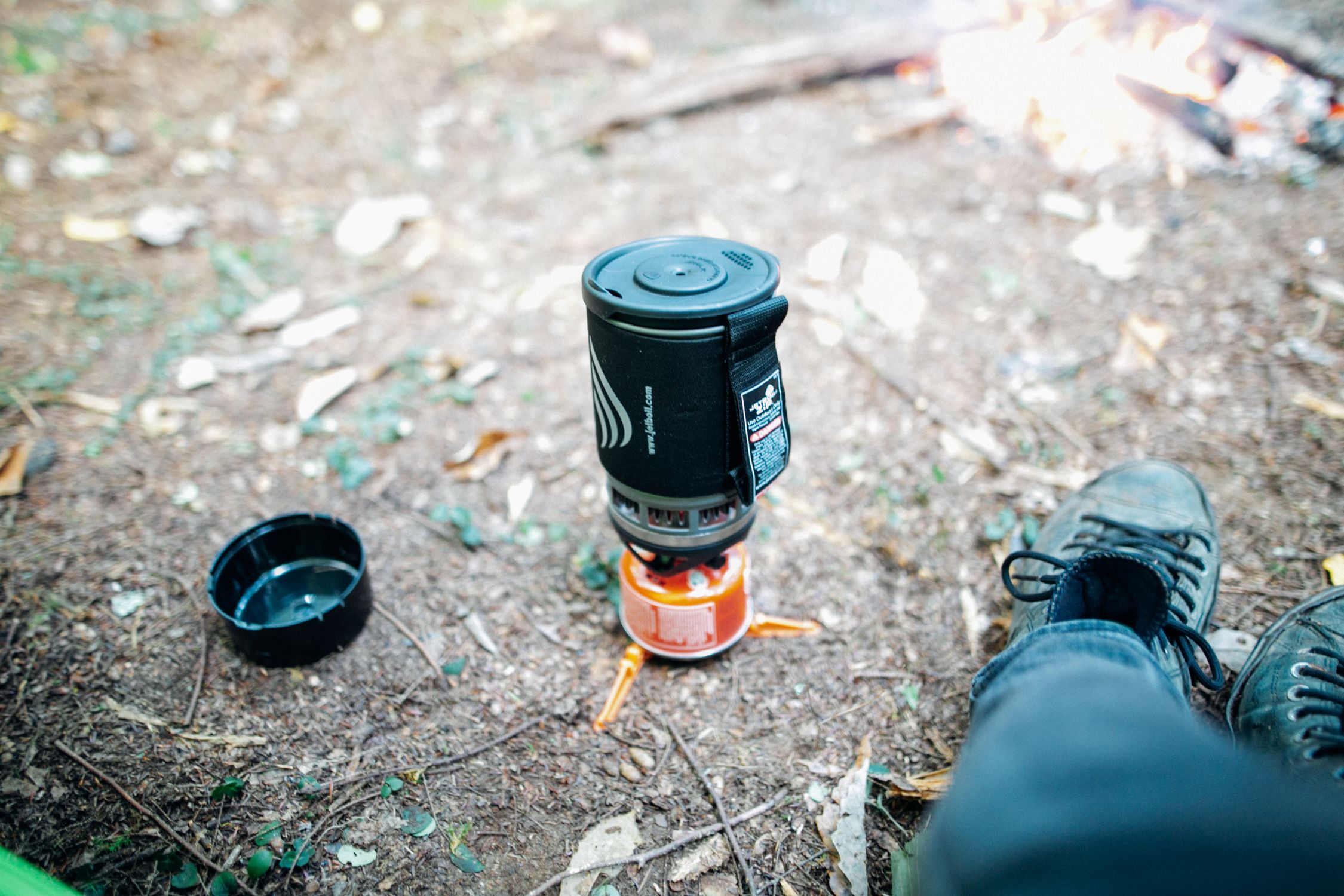
Jetboil Stash — Ultralight Integrated Cooking System
ASIN: B08QRLT8QH — Buy on Amazon — Price: $130-145
- System weight: 7.1 oz (201 g).
- Output: 4,500 BTU.
- Boil time: 2.5 min for 0.8 L.
- Fuel efficiency: 12 L boiled per 100 g canister (approximately 30% better than standard pots).
Best for: Solo thru-hikers optimizing for fuel efficiency over long distances who primarily boil water for freeze-dried meals.
Pros
- FluxRing heat exchanger cuts fuel use by 30% — critical on 2,600-mile trails.
- Entire system (stove, pot, 100 g canister) nests into one compact puck, minimizing pack volume.
- 40% lighter than Jetboil’s next-lightest Flash system while retaining integrated convenience.
Cons
- 0.8 L pot capacity is tight for anything beyond boiling water; not suited for actual cooking.
- At $130+ it is the most expensive option in this roundup for a dedicated boiler.
Snow Peak GigaPower — Manual Stove GS-100R2-US
ASIN: B083V37QPQ — Buy on Amazon — Price: $35-45
- Weight: 75 g (2.64 oz).
- Output: 10,000 BTU.
- Boil time: 4 min 48 sec per liter.
Best for: Hikers who want Japanese precision engineering and a lifetime guarantee at a mid-range price without sacrificing pot-stand stability.
Pros
- Lifetime product guarantee — only stove in this roundup with that level of warranty.
- Ribbed trivet pot support prevents sliding on steep or uneven rests.
- Wide 4-arm fold-out stance handles large pots up to 1.5 L with solid stability.
Cons
- No pressure regulator; output drops noticeably as the canister empties in cold conditions.
- Slowest boil time of the group at 4:48 per liter.
Fire-Maple Blade 2 — Titanium Remote Canister Stove
ASIN: B07V2P2WF2 — Buy on Amazon — Price: $60-80
- Weight: 135 g (4.76 oz).
- Output: 2,800 W (9,500 BTU).
- Cold-weather rating: Rated to 10 degrees F (-12 degrees C).
Best for: Winter thru-hikers, high-altitude adventurers, and shoulder-season hikers who need reliable performance when temps drop below freezing.
Pros
- Remote canister with copper pre-heat tube keeps fuel vaporized and flame stable below 10 degrees F.
- Inverted canister mode delivers liquid feed for maximum cold-weather output — rare at this price point.
- More stable than top-mount canister stoves for cooking with taller pots in wind.
Cons
- Flexible gas hose adds 135 g vs sub-30 g stoves — meaningful weight for true gram-counters.
- Hose and pre-heat tube make packing slightly more fiddly than a compact top-mount stove.
Weight vs Performance Trade-offs
When you compare the six models, a clear gradient emerges:
| Weight (g) | Boil Time (1 L) | Wind Performance | Cold-Weather Regulator |
|---|---|---|---|
| 26 (BRS-3000T) | 3 min | Poor above 15 mph | None |
| 67-87 (SOTO) | under 2.5 min (wind) | Excellent (4-Flex) | Micro-regulator |
| 75 (Snow Peak) | 4 min 48 s | Moderate | None |
| 83 (MSR) | 3.3 min | Good (needle burner) | Pressure regulator |
| 135 (Fire-Maple) | 3 min (cold) | Good (remote canister) | Inverted canister |
| 201 (Jetboil) | 2.5 min (0.8 L) | Integrated windscreen | Integrated regulator (FluxRing) |
For gram-obsessed speedsters on the AT or PCT, the BRS-3000T offers unbeatable weight but demands a windscreen or a calm campsite. The SOTO WindMaster adds a modest weight penalty for a massive wind-resistance gain — ideal for exposed ridgelines where gusts regularly exceed 20 mph. If you need reliable altitude performance without extra accessories, the MSR PocketRocket Deluxe’s pressure regulator is the industry benchmark, confirmed by the 2025 AT survey via The Trek.
The Fire-Maple Blade 2 is the only stove that explicitly addresses sub-10 degrees F operation, making it the go-to for high-altitude passes on the CDT where temperatures can plunge well below freezing. The Pacific Crest Trail Association issued 6,840 long-distance permits in 2024, normalizing post-pandemic thru-hiking volumes — and nearly all those hikers face the same wind and cold challenges these stoves are built to solve.
Cold-Weather Considerations
Cold weather is the Achilles heel of many ultralight canister stoves. Modern isobutane-propane blends stay pressurized down to -12 degrees C (10 degrees F), but as the canister empties, vapor pressure still drops, reducing flame intensity.
- Micro-regulators (SOTO) and pressure regulators (MSR) actively manage this pressure loss, keeping boil times stable.
- Remote canister designs (Fire-Maple Blade 2) pre-heat fuel before it reaches the burner, effectively counteracting the cold-fuel slump.
- Inverted canister mode (Fire-Maple) feeds liquid fuel directly, delivering the hottest flame possible in sub-freezing conditions.
If you anticipate frequent sub-zero nights — think the Sierra Nevada segment of the PCT or the high passes of the CDT — invest in a stove with a regulator or remote canister. The price premium (SOTO $70-80, Fire-Maple $60-80) is offset by the ability to cook reliably when other stoves sputter.
Fuel Efficiency and Cost
Gear cost is a major line item for thru-hikers. Backpacker Magazine’s 2026 cost analysis shows the stove-and-fuel category sits among the top five gear expenditures, with an average AT hiker spending $2,100 on gear in 2025.
- Budget option: BRS-3000T at $15-20 lets you replace a lost stove for the price of a single canister.
- Mid-range value: Snow Peak GigaPower ($35-45) offers a lifetime guarantee, reducing long-term replacement risk.
- Premium performance: SOTO WindMaster and MSR PocketRocket Deluxe sit in the $70-90 range, delivering regulator tech that can shave minutes off boil times and reduce fuel waste.
- Fuel-efficiency champion: Jetboil Stash, despite its $130-145 price tag, boils 12 L per 100 g canister — approximately 30% more efficient than a standard pot. Over a 2,600-mile hike, that efficiency can save $30-50 in fuel costs and reduce pack weight by 30-40 g per 100 g canister saved.
When budgeting, consider replaceability. The 17% of AT hikers who swapped stoves mid-trail in 2025 often did so because a low-cost model failed in wind or cold. A slightly pricier, regulator-equipped stove can prevent that disruption and keep your resupply schedule intact.
Final Verdict: Which Stove Wins Your Trail?
| Trail Type | Priority | Recommended Stove |
|---|---|---|
| Ultra-light AT/PCT (weight under 30 g, calm camps) | Minimal weight, low cost | BRS-3000T |
| Wind-exposed ridgelines (PCT, CDT high passes) | Wind resistance, pot versatility | SOTO WindMaster (add 4-Flex) |
| All-season AT with altitude swings | Regulated output, built-in igniter | MSR PocketRocket Deluxe |
| Fuel-efficiency-obsessed solo | Minimal fuel, compact system | Jetboil Stash |
| Mid-range with warranty | Stability, lifetime guarantee | Snow Peak GigaPower |
| Winter or high-altitude shoulder season | Cold-weather reliability, remote canister | Fire-Maple Blade 2 |
No single stove dominates every scenario, and that’s the beauty of the 2026 market: you can tailor your stove to the exact demands of your route, climate, and gram budget. The rankings above reflect real-world performance, verified by the AT Thru-Hiker Survey, OutdoorGearLab lab tests, and manufacturer specifications. Choose wisely, pack light, and keep that pot boiling — because on a 2,600-mile trek, a hot meal is more than comfort; it’s fuel for the next summit.
Related Reading
Get price-drop alerts and new guides from BoldTripGuide
One email a week: price drops on the gear we recommend, new guides, and what changed. No spam, unsubscribe anytime.