Best Inflatable Kayaks for Adventure Camping 2026
The best inflatable kayaks for 2026 that fit in a checked bag and handle Class III whitewater, coastal paddling, and alpine lake camping. Ranked by portability, durability, and tracking.

This post may contain affiliate links. Disclosure
The hardest part of a backcountry kayak trip used to be getting the kayak there. Hard-shell touring boats demand roof racks, long driveways, and a second person to carry them down to the water. They don’t fit in an overhead bin. They don’t check as luggage. They don’t get strapped to a pack and hiked into an alpine lake.
Inflatable kayaks have solved that access problem so thoroughly that experienced paddlers — people who once dismissed inflatables as pool toys — now bring them on international expeditions. The technology gap between hard-shell and inflatable performance has closed faster than most paddlers expected. Drop-stitch construction produces inflatable floors stiffer than fiberglass. High-denier Polykrylar PVC and reinforced welded seams outlast the abuse of Class III whitewater and rocky shorelines. Some of these kayaks pack down to the size of a duffel bag and weigh under 30 lbs.
The question in 2026 isn’t whether an inflatable can perform — it’s which one matches your specific adventure style. Here are the five best, ranked for adventure campers who care about portability, durability, and getting somewhere most paddlers can’t.
Short answer: Modern inflatable kayaks pack into a checked bag and still handle Class III whitewater, coastal paddling and alpine lake camping. The Advanced Elements AdvancedFrame takes best overall for touring, the Sea Eagle 380X Explorer handles whitewater and open water, and the Sea Eagle SE370 is the lightest genuinely packable option.
How We Evaluated These Kayaks
We focused on five criteria that separate legitimate adventure kayaks from the inflatable toys that belong in resort pools:
Portability when packed: Weight, packed dimensions, and whether it fits in checked luggage or an airline bag-fee window (typically 62 linear inches / 158 cm combined dimensions).
Construction and durability: Material thickness, seam type (welded vs. glued), and whether the hull is reinforced at high-wear points like the bow, stern, and floor.
Tracking on open water: Whether the kayak holds a straight line without constant correction — critical for coastal paddling, lake crossings, and river flatwater sections between rapids.
Whitewater and rough-water capability: Rated whitewater class, self-bailing capacity, and tube diameter (thicker tubes = more resistance to puncture from rocks).
Setup time and ease: A kayak you’ll actually use is better than a technically superior one you leave in the bag because setup is a 45-minute ordeal.
 Photo by Rachel Claire on Pexels
1. Advanced Elements AdvancedFrame — Best Overall for Touring
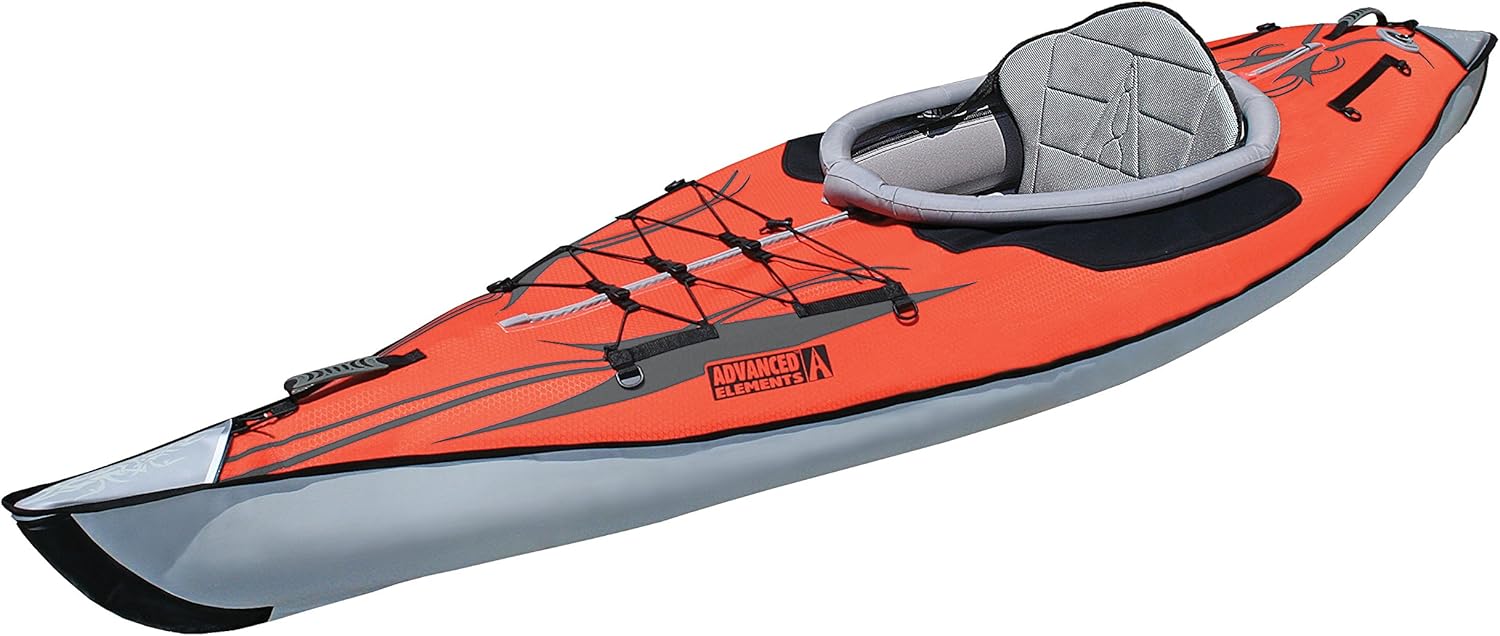
Verdict: The inflatable kayak that paddles like a hard-shell and stows like luggage.
The AdvancedFrame is the benchmark against which serious inflatable touring kayaks get measured, and it earns that position through one design feature that most inflatables skip: aluminum-stiffened bow and stern ribs. Those ribs define the kayak’s shape in a way that pure PVC tubes cannot, giving the AdvancedFrame a pointed, hydrodynamic profile that cuts through water instead of pushing it aside. The result is tracking and paddling efficiency that rival fiberglass boats — a claim that sounds like marketing until you’ve paddled one across a 3-mile lake crossing in a headwind.
The hull is 3-ply reinforced PVC over a polyester core, and the floor sits below the main tubes for a low center of gravity. The full sit-in cockpit design protects your lower body from wind and spray on cold-water coastal approaches. Weight is about 36 lbs — heavier than an ultralight packraft — but well within checked-bag territory. Packed dimensions are approximately 32 x 19 x 10 inches.
Setup takes 10–15 minutes with the included pump. The AdvancedFrame handles flatwater touring, protected coastal paddling, and mild whitewater (Class I–II). It is not a dedicated whitewater boat, but it will handle rivers with technical sections far better than budget inflatables.
Who it’s for: Adventure campers doing lake crossings, coastal touring, and multi-day river trips where hard-shell access is impossible. International travelers who check the kayak as luggage.
Specs: 10.5 ft / 36 lbs / 300 lb capacity / Packed: ~32” x 19” x 10”
Pros: Hard-shell-like tracking, aluminum-rib bow/stern, full cockpit protection, excellent build quality Cons: Heavier than budget alternatives, not self-bailing, setup more complex than tube-style kayaks
2. Sea Eagle 380X Explorer — Best for Whitewater and Open Water

Verdict: Rated Class IV. Self-bailing. Built for paddlers who take rivers seriously.
The 380X sits at the intersection of two kayaking worlds: it’s capable enough for legitimate Class IV whitewater yet handles multi-day coastal touring and alpine lake camping with equal competence. That versatility comes from Sea Eagle’s construction approach: the hull uses 1000-denier reinforced Polykrylar K80 PVC — the same material on the 380X hull as Sea Eagle’s commercial whitewater rafts — with a drop-stitch floor that provides rigid platform stiffness regardless of conditions.
Sixteen floor drains are the 380X’s key whitewater feature. Open them in rapids and water drains continuously, keeping the boat lightweight and responsive even when waves break over the tubes. Close them for flatwater and coastal paddling for a dry ride. The removable skeg improves tracking dramatically on open water; remove it before technical whitewater sections. The 380X handles 1–3 paddlers at a combined weight up to 750 lbs.
At 12 lbs 5 inches and 40 lbs, it packs into a duffel-sized bag. Setup runs about 10 minutes with the included foot pump. The package options (Deluxe and Pro) include paddles, seats, and pump; the Pro package upgrades the seats substantially and is worth the extra cost for multi-day use.
Who it’s for: Paddlers who want one kayak that handles Class III–IV rivers AND multi-day camping expeditions. Whitewater adventurers and expedition paddlers who need a self-bailing platform.
Specs: 12’6” / 40 lbs / 750 lb capacity / Class IV rated / 1–3 person
Pros: Class IV capable, self-bailing with 16 floor drains, military-grade PVC, removable skeg for tracking Cons: Heavier and bulkier than solo touring alternatives, packages add cost, tube-style (less hydrodynamic than AdvancedFrame)
3. Intex Excursion Pro K2 — Best Budget Two-Person

Verdict: Under $300, includes paddles and pump, handles two paddlers comfortably — nothing else at this price point comes close.
The Excursion Pro K2 is the most complete package on this list in terms of what you get out of the box: two 86-inch kayak paddles, a high-output air pump, two fishing rod holders, a GoPro/phone mount, and a repair patch. For a paddler who is new to inflatables and doesn’t want to assemble a kit from scratch, the K2 removes almost all the friction from getting on the water.
The hull is three-ply SuperTough PVC vinyl laminate over a polyester core — significantly more durable than the single-layer PVC on entry-level kayaks, and enough to handle rocky riverbanks, gravel launches, and the general abuse that comes from adventure use. Two removable skegs improve tracking on lake crossings and slow-moving river sections. The 400 lb capacity handles two adults with day-trip gear comfortably.
At 34.6 lbs and 12.7 x 3.1 feet inflated, it’s a full-size touring kayak. The bucket seats are adjustable and genuinely comfortable for half-day trips; for multi-day use, the Pro package seats are worth the upgrade. The K2 converts between solo and tandem configurations — remove one seat and center the remaining paddler for solo day trips.
Who it’s for: Couples and paddling partners who want an affordable, all-inclusive intro to inflatable kayaking. Day-trippers, slow-moving river paddlers, and lake campers on a budget.
Specs: 12.7 ft / 34.6 lbs / 400 lb capacity / 2-person (convertible to solo)
Pros: Everything included out of the box, three-ply PVC, fishing rod holders, GoPro mount, budget price Cons: Not rated for significant whitewater, heavier per person than premium alternatives, seats less comfortable on long days
4. Sea Eagle SE370 — Best Lightweight Packable Option

Verdict: At 33 lbs with a sub-compact bag, this is the inflatable you’ll actually take on the plane without stress.
The SE370 is Sea Eagle’s most portable legitimate kayak — lighter than the 380X, narrower, and packing into a bag roughly the size of a large backpack. That makes it viable as checked luggage on standard international routes without paying oversized fees. Setup takes about 10 minutes with the included pump, and the proprietary Polykrylar K80 hull material handles the kind of abuse that would destroy cheaper inflatables.
The SE370 handles 1–3 paddlers at up to 650 lbs, but its real strength is as a 1–2 person boat where the narrower hull produces noticeably better speed and tracking than wider tube-style kayaks. Two skegs on the bottom keep it honest on lake crossings and slower river sections. It’s rated for Class II whitewater — enough for most river camping approaches, though the 380X is the pick for serious rapids.
The trade-offs versus the 380X are modest: lower whitewater ceiling, slightly less stability on rough water, fewer organizational features. For flatwater-focused adventure campers and international travelers who need to keep the bag dimensions manageable, the SE370 hits a very useful sweet spot.
Who it’s for: Solo and tandem paddlers focused on portability above all else. International travelers flying to remote lake camping destinations. Anyone who regularly hiked or bused to their put-in.
Specs: 12’6” / 33 lbs / 650 lb capacity / Class II rated / 1–3 person
Pros: Lightest capable kayak on this list, airline-friendly dimensions when packed, Polykrylar K80 hull, fast setup Cons: Class II ceiling (not the pick for serious whitewater), fewer features than 380X, modest seat padding in base packages
5. Advanced Elements AdvancedFrame Convertible — Best for Solo or Tandem Flexibility

Verdict: One boat, two configurations — the most versatile platform for group adventure camping.
The AdvancedFrame Convertible stretches to 15 feet and can be paddled solo (with a center seat and spray deck) or tandem (two paddlers fore and aft). That flexibility matters for adventure camps where the group composition changes — or where you want to switch between meditative solo morning paddles and tandem efficiency on long lake crossings with a partner.
It shares the AdvancedFrame’s aluminum-rib bow and stern construction, giving it the same exceptional tracking advantage over pure tube inflatables. The drop-stitch floor option (on the Elite SE variant) upgrades the floor stiffness further, producing performance that genuinely surprises paddlers coming from hard-shell backgrounds. The 15-foot length improves tracking and glide versus the 10.5-foot solo model.
At roughly 52 lbs for the standard Convertible, it’s the heaviest pack on this list — a two-person carry or heavy rolling bag situation at the put-in. Packed size is correspondingly larger. But for camps where the kayak arrives by vehicle and lives at the water’s edge for a multi-day stint, the flexibility of solo/tandem conversion justifies the bulk.
Who it’s for: Adventure camping groups with variable paddling configurations. Couples who want the option to paddle separately or together. Camps with vehicle access to the put-in.
Specs: 15 ft / ~52 lbs / 550 lb capacity (solo or tandem) / Class I–II
Pros: Solo/tandem convertible, aluminum-rib hard-shell performance, drop-stitch floor option, 550 lb capacity Cons: Heaviest and largest packed size on this list, not airline-friendly as checked bag, premium price
Which Inflatable Kayak Should You Take on a Plane?
The airline question deserves its own section because the rules vary and getting it wrong costs money.
Standard checked bag limits at most international carriers run 50 lbs and 62 linear inches combined (length + width + height). Here’s how the five kayaks above stack up against those limits when packed:
Flies easily under standard checked limits: Sea Eagle SE370 (33 lbs, compact bag), Intex Excursion Pro K2 (34.6 lbs, standard duffel size)
Marginal — check your airline’s policies: Advanced Elements AdvancedFrame solo (36 lbs, 32” x 19” x 10” = 61 linear inches — just under most limits)
Likely oversized — verify before booking: Sea Eagle 380X (40 lbs), Advanced Elements Convertible (52 lbs)
For destinations served by budget carriers with strict oversize fees, the SE370 is the pick. For trips where you’re checking a second bag anyway and the airline has a 70 lb limit (common on international routes), the AdvancedFrame and 380X clear the bar easily.
Also worth knowing: most inflatable kayaks in these durable hull materials pass the airline’s “not a dangerous good” test without issue. The paddles are the variable — confirm your airline’s policy on paddle length before packing.
 Photo by Suman Granja on Pexels
Drop-Stitch vs. PVC Tube Construction: What Matters for Adventure Use
The technology divide in inflatable kayaks is between traditional tube construction (air-filled chambers held in shape by the tube diameter) and drop-stitch construction (two fabric panels connected by thousands of threads, inflated to very high pressure for board-like rigidity).
Traditional tube kayaks (Sea Eagle 380X, SE370, Intex K2): Lighter per dollar, more forgiving when rocks hit the hull (the tube flexes rather than cracks), easier to patch in the field, and handles rough water with a more cushioned feel. The downside is tracking — tubes push water laterally rather than cutting through it.
Drop-stitch floors (Advanced Elements AdvancedFrame Convertible Elite): Dramatically stiffer floors produce efficient energy transfer from paddle stroke to forward motion, similar to a hard-shell. The tradeoff is a more complex patching process if punctured and higher cost.
For most adventure campers doing lake crossings and river approaches rather than dedicated whitewater runs, the tube construction of the Sea Eagle lineup provides the best value. For performance-obsessed paddlers, the AdvancedFrame’s aluminum-rib system is the more accessible path to hard-shell-like feel.
For more on expedition paddling routes and multi-day water trips, see our sea kayaking expeditions guide and expedition kayaking multi-day overview. New to packrafts? Our packrafting beginner’s guide covers the lighter-weight alternative for technical river access.
The American Canoe Association’s kayak safety guidelines and Sea Eagle’s official spec sheets are the two best external references for understanding ratings and safety standards before a trip.
Related Reading
Get price-drop alerts and new guides from BoldTripGuide
One email a week: price drops on the gear we recommend, new guides, and what changed. No spam, unsubscribe anytime.