Best Emergency Bivvy Sacks for Ultralight Hiking 2026
Top emergency bivy sacks tested for heat retention, packability, and durability in 2026. From foil emergency sacks to proper overnight bivy systems — find the right one.

This post may contain affiliate links. Disclosure
A day hike goes sideways faster than most people expect. A rolled ankle two miles from the trailhead. A thunderstorm that rolls in an hour ahead of forecast. A wrong turn that adds four miles to a planned six-mile loop. In any of these scenarios, the difference between a miserable but safe night out and a genuine hypothermia emergency can be a 3-oz bivy sack stuffed into the bottom of your daypack. The problem is that “emergency bivy” covers a wide range of products — from cheap foil blanket bags that tear on the first use to properly engineered bivy systems that function as solo shelters in sustained bad weather. This guide ranks five verified options across that spectrum, with honest assessments of what each product actually does at 35°F in wind versus what the spec sheet implies.
Short answer: Emergency foil sacks and proper overnight bivies are different products sold under the same name. A 3 oz foil bivy is insurance for an unplanned night out and disappears into a daypack; a breathable shell like the Outdoor Research Helium is a genuine shelter you can sleep in repeatedly. Buy for the scenario you actually face.
Emergency Foil vs. Proper Bivy: Know the Difference Before You Buy
The gear industry uses “emergency bivy” loosely, and it matters which category you’re buying.
Foil emergency sacks (think space blanket in bag form) are made from metallized polyester film — sometimes called Mylar, though that’s a brand name. They reflect radiated body heat very effectively, around 70-90%, and weigh almost nothing. The tradeoff: they don’t breathe at all, so condensation builds up inside from your own body moisture. They also tear easily. Most are genuinely emergency-only products — designed to be used once, discarded, and replaced. They are better than nothing by a large margin.
Soft-shell emergency bivies like the SOL Escape series use a proprietary fabric (ThermaShell in SOL’s case) that is breathable enough to reduce condensation while still reflecting significant body heat. These are reusable, tougher, and genuinely comfortable for an unplanned night out. They cost more but serve a fundamentally different function.
Ultralight bivy systems like the Outdoor Research Helium are actual sleeping shelters — waterproof, breathable, with a bug screen and an optional pole — designed to replace a tent for minimalist overnight trips. They’re the most expensive category and the most capable.
Knowing which problem you’re solving makes the purchase straightforward.
 Photo by Araz Yurtseven on Pexels
1. SOL Escape Bivvy with Hood — Best Soft-Shell Emergency Bivy
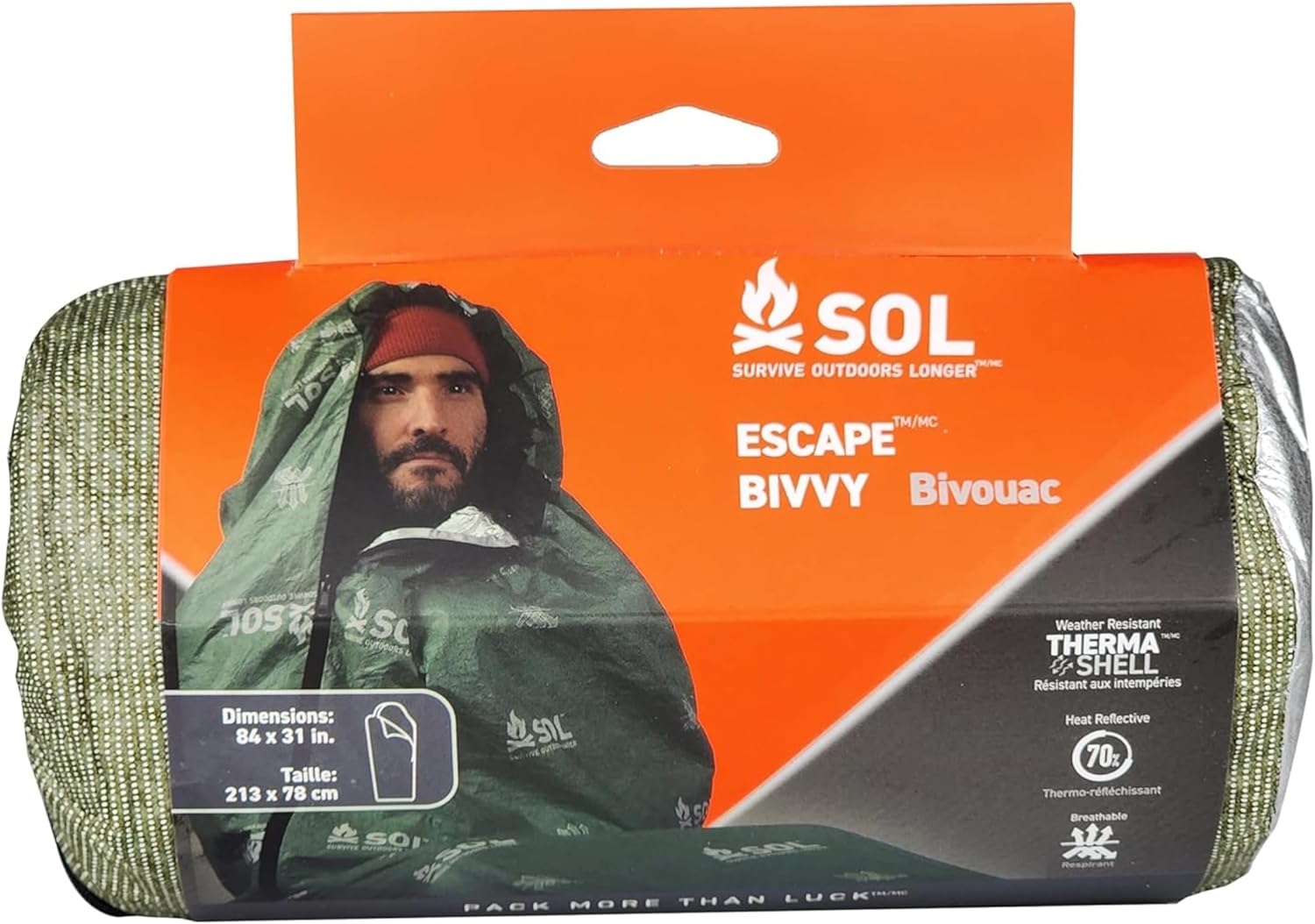
SOL Escape Bivvy with Hood on Amazon
ASIN: B0D5T1YJYH | Rating: 4.5 stars | Price: ~$50
Verdict: The SOL Escape Bivvy with Hood is the best combination of genuine breathability, heat retention, and packability in the emergency bivy category. It belongs in every day hiker’s pack.
SOL’s proprietary ThermaShell fabric is the differentiator here. Unlike metallized foil, ThermaShell is a spun-bonded olefin laminate that reflects approximately 70% of radiated body heat back to you while allowing moisture vapor to escape. The practical result: you stay meaningfully warmer than a foil blanket would achieve, and you don’t wake up soaked in condensation. The water-resistant construction blocks light rain and wind. The added hood (absent on the basic Escape Bivvy) wraps the head and shoulders for dramatically improved warmth in cold conditions.
At 8.6 oz and packed to roughly 4 x 7.5 inches, the Escape Bivvy with Hood is slightly heavier than a pure foil option but lighter than any reusable overnight bivy system. It compresses easily into a hip-belt pocket or the lid of a daypack. The construction is durable enough for repeated use across multiple seasons.
Outdoor Gear Lab’s testing confirms the Escape Bivvy consistently outperforms foil alternatives in real cold conditions — it adds effective warmth in temperatures down into the low 30s, which covers the danger zone for most day-hiking emergencies.
Who it’s for: Day hikers and backpackers who want legitimate emergency protection without carrying a full bivy system. The single most practical safety addition to a day pack.
Pros: Breathable ThermaShell fabric reduces condensation, 70% heat reflection, hood adds critical warmth for head and neck, water-resistant, reusable, compact packed size.
Cons: Not fully waterproof (water-resistant only), won’t perform in heavy sustained rain without additional shelter, slightly heavier than foil alternatives.
2. Survival Frog Tact Bivvy 2.0 — Best Budget Foil Emergency Bivy

Survival Frog Tact Bivvy 2.0 on Amazon
ASIN: B07C45T3Z8 | Rating: 4.6 stars | Price: ~$25
Verdict: The Tact Bivvy 2.0 is the best value emergency foil bivy on the market — tougher than typical space blanket alternatives, loaded with useful extras, and priced where it belongs in the “buy one for every pack” category.
Survival Frog constructs the Tact Bivvy from military-grade tear-proof PET Mylar that reflects 90% of body heat — a higher reflection rate than SOL’s ThermaShell. The tradeoff is that it does not breathe, so condensation accumulates inside during extended use. For a true emergency scenario where you need maximum heat retention for a few hours until rescue or morning light, that’s an acceptable compromise. The material is substantially more durable than the thin foil blankets sold for under $5 at gas stations — it can be repacked and reused multiple times.
The Tact Bivvy includes a stuff sack, a carabiner, a survival whistle, and ParaTinder fire-starting material — extras that make it a functional emergency kit component rather than just a bag. The whistle in particular is worth having alongside any bivy.
The 4.6-star rating across thousands of Amazon reviews reflects real-world performance: customers report staying dry in rain, staying genuinely warm through cold nights, and appreciating the durability advantage over single-use foil alternatives.
Who it’s for: Budget-conscious hikers, trail runners doing long-distance events, anyone who wants an emergency bivy in every pack without spending $50 per unit.
Pros: 90% heat reflection, more durable than standard foil blankets, includes whistle and fire-starting material, excellent price point, reusable.
Cons: Does not breathe — condensation builds up with extended use. Not an overnight sleeping system.
3. Outdoor Research Helium Bivy — Best Ultralight Overnight Bivy System

Outdoor Research Helium Bivy on Amazon
ASIN: B0DCKDM4MB | Rating: 4.4 stars | Price: ~$299
Verdict: The OR Helium is not an emergency bivy — it’s a legitimate ultralight shelter system that has earned a position as one of the most-awarded bivy sacks ever made. If you want a bivy that replaces a tent for fast-and-light missions while handling genuine overnight conditions, the Helium delivers.
The construction uses Pertex Shield+ 2.5-layer nylon ripstop on top and 40D nylon with TPU coating on the bottom floor — fully waterproof, breathable, and seam-taped throughout. The overhead pole creates real headspace so the bivy doesn’t press against your face all night. A no-see-um bug screen keeps insects out without blocking airflow. The entry zipper runs along the top for easy in-and-out access without exposing the sleep area to rain.
At 15.8 oz and packed to 4 x 12.5 inches, the Helium is the heaviest option in this guide by a significant margin — but you’re paying for a functional overnight shelter, not just emergency protection. Outdoor Gear Lab rates it their top overall bivy sack pick, and at the price point, that’s warranted.
The Helium is the right tool for alpine climbers, fastpackers who might bivouac intentionally, and minimalist backpackers who want to ditch tent poles and stakes entirely.
Who it’s for: Fastpackers, alpine climbers, and ultralight backpackers who treat the bivy as their primary shelter rather than a backup.
Pros: Fully waterproof and seam-taped, Pertex Shield+ breathable construction, integrated overhead pole for headspace, bug screen, OR’s most-awarded bivy.
Cons: Expensive at ~$299, heavy compared to emergency-only options, requires practice to enter and exit efficiently in the dark.
4. Go Time Gear Life Bivy — Best All-Rounder Emergency Foil Bivy

Go Time Gear Life Bivy on Amazon
ASIN: B09WSHG5P4 | Rating: 4.5 stars | Price: ~$20
Verdict: The Go Time Gear Life Bivy is the closest competitor to the Survival Frog Tact Bivvy and edges it out on packability — the stuff sack measures just 4 x 3 inches and the bivy weighs 4.1 oz, making it genuinely pocketable.
The material is military-grade PET Mylar with a reflective interior that the brand claims reflects 90% of body heat. Construction quality is solid for the price — tear-resistant compared to thin foil blankets, windproof and waterproof enough to block the immediate elements. The Life Bivy includes a 120-decibel survival whistle and a 20-foot paracord, both useful inclusions for a stranded hiker.
The Mylar construction shares the same condensation limitation as all foil bivies — it traps moisture as well as heat — but for emergency use scenarios that are measured in hours rather than days, that’s manageable. The Life Bivy is genuinely windproof and waterproof against rain, which addresses the acute hypothermia risk of wet and cold exposure.
Who it’s for: Hikers who want the smallest possible emergency bivy footprint at the lowest price. A strong “one in every pack” choice for large groups or for equipping multiple vehicles with survival kits.
Pros: Extremely compact at 4 x 3 inches, 90% heat reflection, includes whistle and paracord, windproof and waterproof construction, very affordable.
Cons: Foil construction does not breathe, condensation accumulates inside, single-use tendency despite being marketed as reusable.
5. SOL Escape Lite Bivvy — Best Pure Emergency Sack for Day Hikers
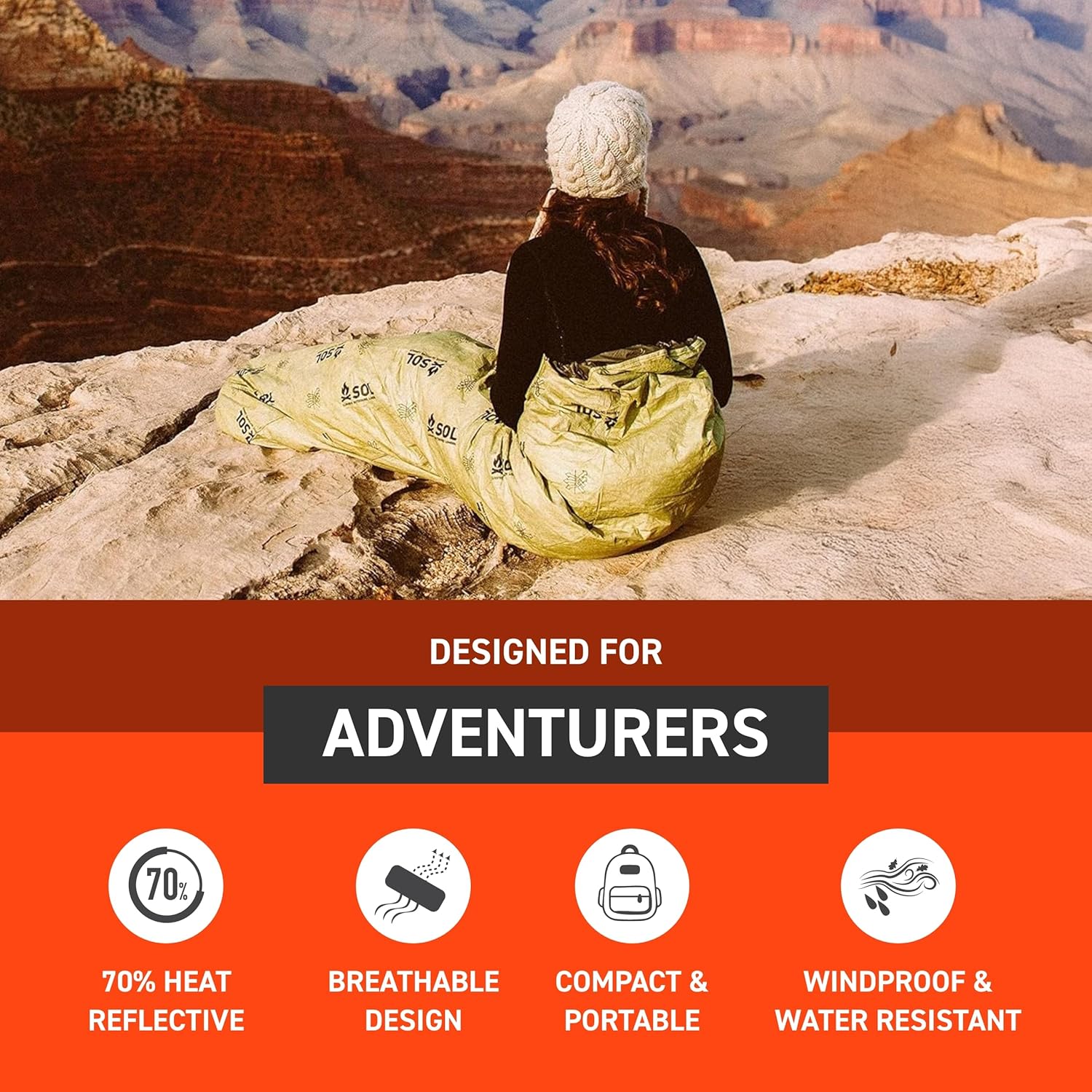
SOL Escape Lite Bivvy on Amazon
ASIN: B00EZEXCBG | Rating: 4.4 stars | Price: ~$35
Verdict: The SOL Escape Lite is the no-frills ThermaShell option for hikers who want the breathability advantage of the full Escape Bivvy at a lower price point and without the hood. It trades a few ounces and the hood for roughly $15 in savings.
At 5.5 oz and 82 x 32 inches interior, the Escape Lite is the smallest ThermaShell bivy SOL makes. The same proprietary fabric provides genuine breathability and approximately 70% heat reflection — a meaningful advantage over foil alternatives in damp conditions where condensation management matters. The water-resistant (not waterproof) construction blocks light rain and wind.
The Escape Lite is the right pick if you carry it specifically as an emergency layer for day hikes in shoulder seasons — spring and fall — when unexpected cold and wet weather is possible but sustained severe conditions are unlikely. If you’re venturing into high alpine terrain or genuinely exposed winter conditions, step up to the hooded version or the full Helium system.
Who it’s for: Day hikers and trail runners who want better breathability than foil at a price point under $40.
Pros: ThermaShell breathability reduces condensation versus foil options, 70% heat reflection, water-resistant, reusable across multiple seasons, lighter than the hooded version.
Cons: No hood (significant warmth loss versus hooded version), water-resistant not waterproof, not appropriate as a primary shelter.
 Photo by Matthew DeVries on Pexels
What Temperature Will an Emergency Bivy Actually Handle?
This is the question most product specs dodge. The honest answer depends on three variables: the bivy’s heat-reflection rating, what you’re wearing inside it, and wind exposure.
A 90%-reflective foil bivy like the Tact Bivvy 2.0 will add roughly 10-15°F of effective warmth if you’re wearing appropriate base layers. In 35°F weather with light wind and decent synthetic or wool clothing, you will be uncomfortable but not in immediate danger of hypothermia for a few hours. In wet conditions where your clothing is already damp, that margin shrinks significantly.
A breathable ThermaShell bivy like the SOL Escape typically performs better in damp conditions because it manages the moisture-vapor feedback loop that foil bivies can’t address. In the real-world test scenarios that Outdoor Gear Lab uses, hikers sleeping in a ThermaShell bivy at 35°F with a light synthetic sleeping bag report sleeping adequately — not comfortably, but adequately.
The OR Helium, because it’s a full waterproof bivy system rather than an emergency sack, performs reliably down to whatever your sleeping bag’s limit is. It’s a shelter, not an insulation layer.
The practical rule for emergency bivies: they buy you time, not comfort. Carry one in every pack, know how to deploy it quickly, and treat it as the last line of defense rather than the primary plan.
For more on building a complete day-hiking safety kit, see our adventure travel safety essential guide and the comprehensive off-grid wilderness camping guide.
Solo Day Hike Essential Gear Checklist
If you’re adding a bivy to your pack for the first time, here’s the complete safety kit worth building around it:
- Emergency bivy (this guide) — 3-9 oz depending on type
- Navigation: offline maps app + compass backup
- Light: headlamp with fresh batteries
- Water: filtration (Sawyer Squeeze or similar) + 2L capacity
- Fire: waterproof matches or lighter
- First aid: blister kit, pain reliever, wound care basics
- Knife or multitool
- Satellite communicator for trips beyond cell coverage — see our best solar chargers for off-grid adventures for power solutions in remote terrain.
The bivy anchors the kit because hypothermia is the emergency most day hikers are least prepared for. Everything else on this list matters, but getting wet and cold at altitude is the scenario most likely to turn a bad situation into a fatal one.
Final Comparison
| Bivy | Type | Weight | Breathable | Best Use |
|---|---|---|---|---|
| SOL Escape Bivvy with Hood | Soft-shell | 8.6 oz | Yes | Emergency day hike, shoulder season |
| Survival Frog Tact Bivvy 2.0 | Foil | ~4 oz | No | Budget emergency, event racing |
| OR Helium Bivy | Full bivy system | 15.8 oz | Yes | Ultralight overnight shelter |
| Go Time Gear Life Bivy | Foil | 4.1 oz | No | Ultra-compact emergency kit |
| SOL Escape Lite Bivvy | Soft-shell | 5.5 oz | Yes | Budget ThermaShell option |
The SOL Escape Bivvy with Hood is the recommendation for most day hikers — the breathability advantage over foil is real, the heat retention is genuine, and the packed size fits anywhere. The Tact Bivvy 2.0 or Life Bivy make sense when budget or pack space drives the decision. And the OR Helium is the pick when the bivy is the shelter.
Related Reading
Get price-drop alerts and new guides from BoldTripGuide
One email a week: price drops on the gear we recommend, new guides, and what changed. No spam, unsubscribe anytime.